Emteq Labs Blog & Scientific Updates
Explore the latest articles on optomyography (OCO™), facial expression sensing, XR biofeedback, and affective computing.
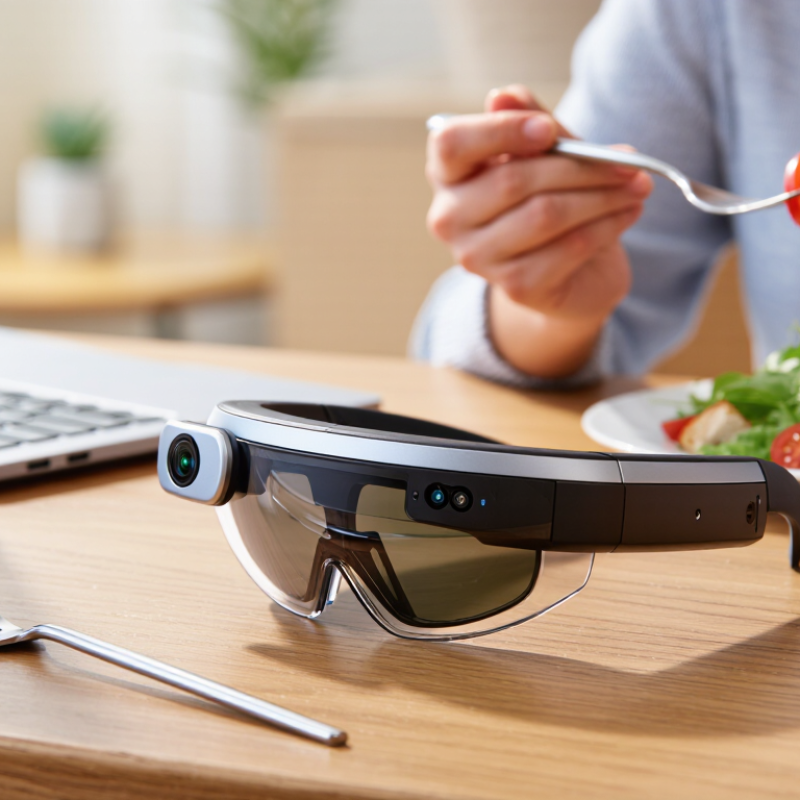
Eating behavior monitoring glasses are moving from experimental laboratories toward practical nutrition, wellness, and human-computer interaction applications. These devices may use cameras, motion sensors, microphones, or artificial intelligence to identify bites, chewing patterns, meal duration, and hand-to-mouth movements. A small frame can record a surprisingly complex routine: a fork lifted, a pause between bites, or a distracted snack beside a bright laptop.
Researcher A. Thomaz, whose work explores wearable systems and eating recognition, offers a useful principle: “Technology should support awareness, not replace human judgment.” That idea matters. Eating behavior monitoring glasses should not diagnose conditions, shame users, or promise instant weight-loss results. Their value depends on accurate sensing, transparent data practices, comfortable design, and responsible interpretation.
This Top 10 Eating Behavior Monitoring Glasses Manufacturers guide examines companies shaping this emerging category. The comparison considers sensor capability, software integration, research evidence, privacy controls, battery performance, comfort, and real-world usability. Some manufacturers focus on clinical studies. Others emphasize consumer wellness or smart-glasses platforms.
The market remains immature. Some product claims are stronger than the published evidence. Testing conditions can also differ sharply, from controlled meals to noisy restaurants. That weakness deserves attention, not concealment.
Readers should therefore treat this list as a practical starting point, rather than a medical recommendation. The best manufacturer may not offer the most impressive prototype. It may offer the clearest limitations, the most reliable measurements, and the least intrusive everyday experience.
Market Scope: 10 Eating-Behavior Monitoring Glasses Manufacturers
The market scope covers ten eating-behavior monitoring glasses manufacturers with different technical strengths. Some focus on bite detection, while others measure chewing rhythm, meal duration, or hand-to-mouth movement. Their products may combine miniature cameras, motion sensors, microphones, and companion software. However, sensor accuracy can change under poor lighting, noisy rooms, or unusual eating habits. A reliable comparison should examine published testing methods, sample sizes, calibration procedures, and real-world user feedback.
Evaluation also includes frame comfort, battery life, data processing, and device compatibility. Manufacturers with clinical research partnerships may offer stronger evidence, but research quality still requires careful review. Privacy design matters because eating patterns can reveal health-related information. Secure storage, clear consent settings, and limited data collection should remain basic expectations. No ranking is perfect. Some technical claims may appear impressive before independent validation confirms them.
Tips: Compare measurement accuracy with comfort during a full meal. Ask whether the device works with glasses prescriptions and different face shapes. Check how raw recordings are handled, deleted, or shared. Reviewers should test hot foods, quick snacks, and quiet meals. Results may vary. Keep that limitation visible.
| Rank | Anonymous Manufacturer Profile | Market Status | Primary Monitoring Approach | Typical Sensor Configuration | Behavioral Indicators Captured | Target Application | Data Connectivity | Technology Readiness | Key Market Strength |
|---|---|---|---|---|---|---|---|---|---|
| 1 | Profile A | Commercial | Computer-vision analysis of hand-to-mouth activity | RGB camera, inertial measurement unit, ambient-light sensor | Bite frequency, eating duration, hand movement, meal intervals | Clinical nutrition studies and digital health research | Bluetooth Low Energy, mobile application, encrypted cloud dashboard | TRL 8–9 | Continuous passive monitoring with wearable form factor |
| 2 | Profile B | Commercial | Jaw-motion and chewing-pattern recognition | Inertial sensors, motion accelerometer, gyroscope | Chewing cycles, chewing rate, pauses, swallowing-related motion | Behavioral nutrition and obesity-management programs | Bluetooth Low Energy with smartphone synchronization | TRL 8–9 | Low-light operation without depending entirely on visual capture |
| 3 | Profile C | Pilot Deployment | Multimodal recognition of utensils, food, and eating gestures | RGB camera, depth sensor, IMU, proximity sensor | Food approach, utensil use, bite size estimation, eating pace | University-led dietary behavior and human-computer interaction studies | Wi-Fi or Bluetooth gateway with local data processing | TRL 6–8 | Broader contextual interpretation of eating episodes |
| 4 | Profile D | Commercial | Head-position and facial-motion tracking | Inertial measurement unit, camera, infrared proximity sensor | Head orientation, mouth-opening events, meal start and end times | Remote patient monitoring and assisted-living services | Bluetooth Low Energy, smartphone app, application programming interface | TRL 8 | Hands-free monitoring suitable for daily routines |
| 5 | Profile E | Pilot Deployment | Audio-based chewing and swallowing event detection | Bone-conduction or contact microphone, IMU, digital signal processor | Chewing sound, swallowing events, chewing duration, pause patterns | Swallowing assessment and diet-consistency research | Local storage with periodic Bluetooth transfer | TRL 6–7 | Privacy-oriented sensing with limited visual data collection |
| 6 | Profile F | Commercial | Eating-event classification using embedded edge artificial intelligence | Camera, IMU, edge processor, ambient-light sensor | Eating episodes, meal duration, hand-to-mouth gestures, interruptions | Consumer wellness and nutrition coaching | Bluetooth Low Energy with optional cloud analytics | TRL 8 | Reduced latency and lower raw-data transmission requirements |
| 7 | Profile G | Research Prototype | Eye-gaze and visual attention analysis during food selection | Eye-tracking cameras, RGB camera, inertial sensors | Food fixation, visual preference, selection time, distraction level | Consumer psychology and food-choice experiments | Wi-Fi tethering or wired research workstation connection | TRL 4–6 | Links eating behavior with visual attention and decision-making |
| 8 | Profile H | Pilot Deployment | Gesture recognition combined with meal-context logging | Wide-angle camera, IMU, GPS, ambient-light sensor | Meal location, eating frequency, social context, hand activity | Population nutrition surveys and real-world dietary research | Bluetooth, Wi-Fi, and secure research data portal | TRL 6–7 | Captures environmental context alongside eating actions |
| 9 | Profile I | Research Prototype | Facial electromyography and jaw-activity measurement | Surface electromyography electrodes, IMU, signal-conditioning module | Muscle activation, chewing intensity, chewing rhythm, fatigue indicators | Biomechanics, rehabilitation, and swallowing research | Short-range wireless link with laboratory software | TRL 4–6 | High-resolution physiological measurement of mastication |
| 10 | Profile J | Pilot Deployment | Hybrid recognition of eating gestures and spoken meal notes | Camera, microphone, IMU, touch or voice-control interface | Meal timing, eating speed, food-related notes, adherence patterns | Personalized nutrition coaching and clinical trial support | Bluetooth, smartphone speech processing, cloud reporting | TRL 6–8 | Combines automated observation with user-confirmed dietary context |
FAQS
They may track bites, chewing rhythm, meal duration, or hand-to-mouth movement. Some systems use motion sensors, microphones, cameras, or combined signals.
It combines an accelerometer, gyroscope, and magnetometer. These sensors record head direction, movement speed, and small motion changes during eating.
No. Higher rates may capture quick gestures, but they can increase battery use, storage needs, and signal noise. More data is not automatically better.
Sensor fusion may compare movement, temperature, proximity, or optical signals. A sip and a brief head turn can still look similar.
Poor lighting, noisy rooms, unusual eating habits, and metal equipment can affect results. Magnetometers may behave poorly near kitchen appliances or metal tables.
Ask for sample sizes, calibration procedures, sampling settings, missing-data rates, and testing conditions. Independent meal studies usually offer stronger evidence than demonstrations.
Comfort depends on frame shape, prescription compatibility, face size, and battery weight. Test them during a complete meal, not only for five minutes.
Data should use secure storage, clear consent controls, limited collection, and simple deletion options. Eating patterns can reveal sensitive health information.
No. Updates may improve classification, but they cannot repair weak sensors or unclear behavior labels. Results can drift.
Conclusion
This article presents a structured review of the top 10 Eating behavior monitoring glasses manufacturers, focusing on how their products detect and interpret eating-related movements. The market scope covers devices equipped with 9-axis inertial measurement units, sampling rates between 50 and 200 Hz, and sensor-fusion methods that combine motion data with contextual signals. Key evaluation metrics include precision, recall, F1 score, battery runtime, and the reliability of real-world data collection.
Each manufacturer profile is assessed through its product design, patent activity, clinical-trial evidence, and manufacturing scale. The comparison framework also examines recognition accuracy, user privacy, comfort, purchase and operating costs, and compatibility with health or research data systems. By combining technical performance with practical usability, the article offers a neutral basis for comparing Eating behavior monitoring glasses and identifying solutions suitable for academic studies, wellness programs, and responsible long-term behavior analysis.