Emteq Labs Blog & Scientific Updates
Explore the latest articles on optomyography (OCO™), facial expression sensing, XR biofeedback, and affective computing.
7 Best Wearable Facial Biofeedback Hardware Options?
Table of Contents
- What Wearable Facial Biofeedback Hardware Measures and How It Works
- Key Criteria for Evaluating Facial Biofeedback Devices
- Seven Wearable Facial Biofeedback Hardware Options Compared
- Best Device Types for Different Training and Wellness Goals
- Safety, Comfort, Privacy, and Practical Use Considerations
- FAQS
- Conclusion
- Related Posts
Facial expressions can reveal tension before people consciously notice it. A clenched jaw, raised brow, or tightening around the eyes may signal stress, fatigue, or emotional strain. Wearable facial biofeedback hardware turns these subtle movements into measurable feedback through sensors, mobile applications, or guided visual cues. This guide examines seven hardware options designed for different practical needs, including facial electromyography, motion tracking, skin-response sensing, and multimodal systems.
The comparison focuses on sensor placement, comfort, signal quality, battery life, software support, and privacy safeguards. A device that looks elegant may still feel distracting after twenty minutes. Another may collect detailed data but offer weak feedback tools. Small differences matter. We consider how each option performs during desk work, meditation, therapy-informed exercises, and controlled research settings. Claims are assessed against manufacturer documentation, published evidence, and real-world usability rather than marketing language alone.
No wearable can interpret emotion perfectly. Facial signals vary between individuals, cultures, lighting conditions, and physical activities. That limitation deserves attention. Users should treat feedback as a prompt for reflection, not a medical diagnosis or final judgment about their feelings. Clinical use should involve qualified professionals, especially when anxiety, trauma, pain, or neurological symptoms are involved. Data handling also matters: clear consent, secure storage, and understandable deletion controls should be expected. The strongest choice may not be the most advanced model. It may be the one that stays comfortable, explains its readings clearly, and supports consistent, informed practice. Our ranking remains practical, but some evidence is still developing.
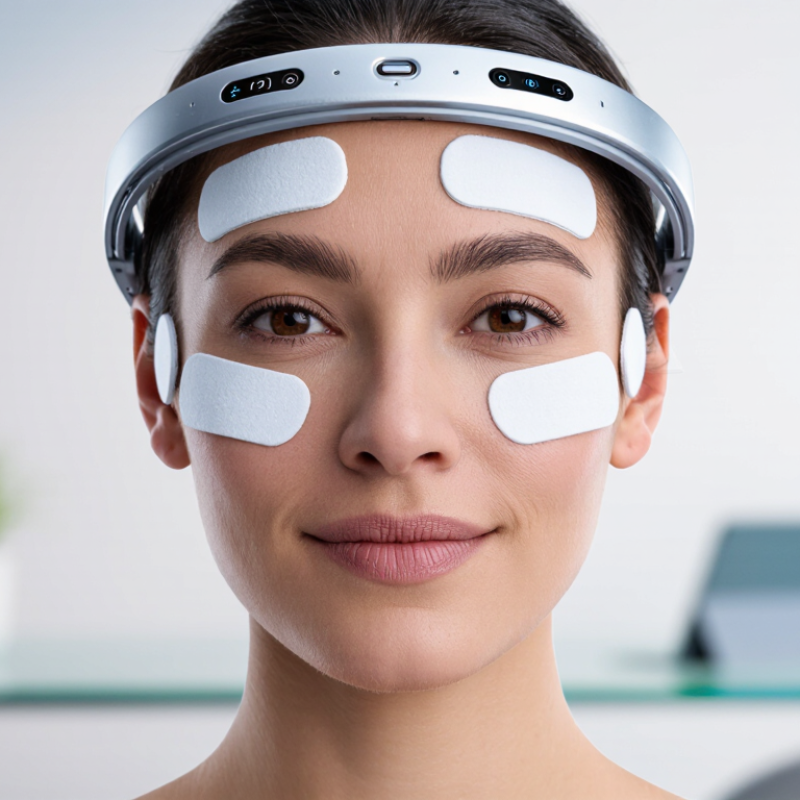
What Wearable Facial Biofeedback Hardware Measures and How It Works
Wearable facial biofeedback hardware measures body signals linked to facial movement, stress, and attention. Small surface electrodes can record facial electromyography, or EMG, around the brow and jaw. Optical sensors may track pulse changes, while skin conductance sensors estimate sweating. Motion sensors identify head position, blinking, and muscle tension. The device sends these signals to software, which provides vibration, sound, or visual feedback.
The mechanism is practical but not magical. When brow activity rises, the system may recognize tension and prompt slower breathing. A jaw sensor can reveal repeated clenching during work or sleep.
A 2023 systematic review in Sensors reported growing use of wearable signals for stress monitoring, but also noted inconsistent validation methods. That matters. Facial tension can reflect concentration, pain, cold air, or poor electrode contact.
Industry data gives useful context. The International Data Corporation’s 2024 wearable device tracker reported about 537.9 million wearable shipments worldwide. Yet popularity does not prove clinical accuracy. The American Psychological Association’s Stress in America reporting has repeatedly shown that many adults experience physical stress symptoms, creating demand for self-monitoring tools.
Still, users should treat feedback as a prompt, not a diagnosis. I would question any device claiming to “read emotions” directly. Skin changes quickly. Facial muscles do too. Calibration, skin fit, movement, and personal baseline can change the result. Careful users should compare readings with a diary and real situations. Some feedback may be wrong.
Key Criteria for Evaluating Facial Biofeedback Devices
Choosing among the 7 best wearable facial biofeedback hardware options requires more than comparing features.
The key question is whether the device captures meaningful facial signals during real movement. Look for stable sensors, secure placement, and clear calibration instructions. A device should remain comfortable during speaking, walking, and natural expression. Tight pressure can distort readings and quickly discourage regular use. In practice, reliable data matters more than an impressive specification sheet.
Evaluate signal accuracy, response time, battery life, and software transparency. Facial movement can create noise, especially near the jaw, forehead, or eyes. Strong hardware separates muscle activity from motion artifacts and explains its measurement limits.
Independent testing, published methods, and repeatable results support credibility. Check whether the system protects recordings and allows users to export raw data. Avoid tools that make clinical claims without qualified evidence. That is a warning sign.
Personal testing still matters, because skin texture, facial hair, and sensitivity vary widely. I would not treat one successful session as proof of accuracy.
Tips:
Wear the device for ten minutes before judging comfort. Test calm breathing, conversation, and deliberate expressions. Compare repeated sessions under similar conditions. Note slipping, delayed feedback, and confusing charts. If results change dramatically without a clear reason, pause and investigate calibration. A simple paper log can reveal patterns that software overlooks. Perfect measurement is unlikely. Honest limitations are valuable.
Seven Wearable Facial Biofeedback Hardware Options Compared
Wearable facial biofeedback hardware varies by signal, placement, and comfort. Adhesive EMG patches measure muscle activity near the forehead or jaw. They offer precise readings, but skin preparation and cable movement can affect results. Soft forehead bands are easier to wear during daily practice. Their wider contact area may reduce accuracy when hair, sweat, or shifting fabric interferes.
Temple-mounted muscle sensors focus on clenching and facial tension. They suit relaxation training, although chewing can create confusing data. Jaw-motion sensors detect movement rather than electrical activity. They can help users notice repeated clenching, but they may miss subtle tension. Blink-sensing glasses use small optical or electrical sensors around the eyes. They are useful for blink patterns, yet bright light and glasses fit can distort measurements.
A lightweight facial camera mask can track expressions without skin electrodes. It feels less restrictive, but lighting and privacy require careful attention. Multimodal headsets combine facial EMG, eye activity, and sometimes pulse signals. They provide broader context, though more sensors mean higher cost, calibration demands, and data complexity. No option wins everywhere. In practical evaluations, signal quality matters more than a polished interface. Users should check sampling methods, calibration steps, cleaning requirements, and data storage policies. A comfortable device encourages consistent use. Still, a neat graph can mislead if movement artifacts remain unchecked. Independent validation is worth seeking, especially when results influence health decisions.
Best Device Types for Different Training and Wellness Goals
The best wearable facial biofeedback device depends on your training goal, not its feature count. For facial relaxation, a surface electromyography sensor can detect tension around the brow, jaw, and cheeks. It offers useful feedback during meditation or stress practice. Keep it simple. A thermal sensor may suit users who want to observe changing skin temperature during controlled breathing. However, temperature shifts can reflect room conditions, caffeine, or recent exercise.
For attention training, a lightweight headband with electroencephalography sensors may provide basic mental-state feedback. Its readings can be sensitive to hair, movement, and poor electrode contact. For emotional awareness, a facial optical sensor can monitor pulse-related changes near the temple or forehead. It may help users notice arousal before they recognize it consciously. A wearable skin-conductance sensor can support stress tracking, although it is often worn on the wrist rather than the face.
Movement-focused users may prefer a facial motion sensor that measures jaw clenching, blinking, or head position. Athletes could combine it with a respiration band to examine breathing during exertion. A hybrid headset can combine muscle, pulse, motion, and temperature signals, but more data does not guarantee better coaching. Clinical-grade validation matters. Consumer feedback is not a diagnosis. Check sensor placement, calibration steps, privacy controls, and return policies before purchasing. I would also test one goal for two weeks, because impressive dashboards can distract from the habit itself.
7 Best Wearable Facial Biofeedback Hardware Options
Typical operating ranges by device type and the training or wellness goal they support
Higher sampling rates are useful for fast-changing signals such as facial muscle activity and eye movements. Lower-rate signals such as skin temperature and electrodermal activity can still provide valuable feedback for relaxation, stress awareness, and recovery. The ranges shown are representative of common wearable sensor systems; actual specifications vary by device design.
Safety, Comfort, Privacy, and Practical Use Considerations
7 Best Wearable Facial Biofeedback Hardware Options?
Safety, comfort, privacy, and practical use matter more than a polished dashboard. The seven useful formats include forehead bands, temple sensors, smart glasses, ear-worn devices, facial patches, jaw monitors, and textile headgear. Each can track muscle tension, skin response, temperature, or movement. However, sensor placement changes the signal. A patch may loosen with sweat. Glasses can press against the nose. “Comfort is data.”
Check skin-contact materials, charging heat, cable strain, and cleaning instructions before daily use. The U.S. FDA’s 2023 cybersecurity guidance recommends secure updates, access controls, and risk monitoring for connected medical devices. That standard is relevant here, even when a product is marketed for wellness. I would not trust one facial score without calibration. Facial movement varies with speech, lighting, shaving, and fatigue. That assumption deserves challenge.
Privacy needs equal attention. The Verizon 2024 Data Breach Investigations Report analyzed 30,458 incidents, including 10,626 confirmed breaches. Biometric-like facial signals deserve careful handling, even if they are not medical records. The IBM Cost of a Data Breach Report 2024 reported an average global breach cost of 4.88 million dollars. Choose local processing when available, limited data retention, clear deletion controls, and multi-factor account protection. Disable unnecessary microphone access. Test the device during a quiet commute, a workout, and a stressful meeting. Real life exposes flaws that product demonstrations hide.
7 Best Wearable Facial Biofeedback Hardware Options? - Safety, Comfort, Privacy, and Practical Use Considerations
| Hardware option | Primary signal | Typical facial biofeedback use | Safety considerations | Comfort and wearability | Privacy considerations | Practical strengths | Important limitations | Overall suitability |
|---|---|---|---|---|---|---|---|---|
| Facial surface EMG wearable | Electrical activity from facial muscles, such as the brow, cheek, or jaw area | Detecting muscle tension, jaw clenching, frowning, and relaxation responses | Uses low-voltage sensing rather than therapeutic electrical stimulation. Skin irritation and electrode sensitivity are the main concerns. | Very small sensors can be lightweight, but adhesive or gel electrodes may feel restrictive and require careful placement. | Usually produces physiological signal data without recording images. Wireless transmission and stored raw signals still require protection. | Directly measures facial muscle activation and can provide precise, low-latency feedback. | Signals are sensitive to movement, electrode placement, skin impedance, and electrical interference. Setup may require training. | Best for precise facial tension and muscle-control training |
| Dry-electrode EEG headband | Electrical brain activity measured from the scalp | Attention, relaxation, meditation, and awareness of mental-state changes associated with facial tension | Generally non-invasive and passive. Avoid use on damaged skin, and follow electrical-safety instructions for charging and cleaning. | No conductive gel is usually needed, but pressure from the band and contact points can become uncomfortable during long sessions. | Brain-related data can be sensitive. Review whether raw EEG data is stored locally, uploaded, or shared with third parties. | Can offer real-time auditory or visual feedback without attaching sensors to the face. | Facial and eye movements create artifacts, and consumer-grade EEG should not be treated as a diagnostic tool. | Best for meditation and broader neurofeedback routines |
| Wrist electrodermal activity band | Changes in skin conductance associated with sweat-gland activity | Stress or arousal feedback paired with awareness of facial expressions and jaw tension | Passive sensing is typically low risk. Moisture, skin conditions, and tight straps can cause irritation or inaccurate readings. | Usually comfortable and easy to wear, although a snug fit is needed for stable contact. | Usually does not capture images or audio, but time-stamped stress patterns can still reveal sensitive behavioral information. | Simple, portable, and suitable for continuous feedback during daily activities. | EDA reflects arousal, not a specific emotion. Heat, exercise, caffeine, and movement can affect the signal. | Best general-purpose option for stress-awareness training |
| PPG-based wrist or ear wearable | Optical pulse waveform, heart rate, and sometimes heart-rate variability | Breathing and relaxation feedback that helps users observe physiological responses to facial or emotional tension | Uses light-based sensing and is generally non-invasive. Avoid overly tight bands and monitor for skin reactions. | Commonly comfortable for extended wear; ear-based designs may be less suitable for every user or activity. | Physiological data is less visually intrusive than camera data, but cloud accounts and long-term health profiles remain privacy concerns. | Widely understood metrics, easy trend tracking, and useful real-time breathing prompts. | Motion, poor sensor contact, skin tone, ambient light, and irregular rhythms can reduce accuracy. It does not directly measure facial expression. | Best for discreet relaxation and cardiovascular feedback |
| Camera-based smart glasses | Facial landmarks, head position, gaze-related cues, or video-derived expression features | Posture, gaze, facial-expression awareness, and hands-free visual or audio prompts | Avoid use while driving or in situations where visual or audio prompts could distract the wearer. Manage heat, battery, and lens-related discomfort. | Easy to put on but may cause nose, ear, or temple pressure. Fit and prescription-lens compatibility vary. | Highest privacy risk because cameras may capture bystanders, surroundings, and identifiable facial information. Clear recording indicators and consent practices are important. | Provides contact-free sensing and can support immediate, context-aware feedback. | Lighting, occlusion, cultural differences in expression, and algorithmic bias can affect interpretation. Expression is not a definitive measure of emotion. | Best for contact-free, hands-free facial and posture feedback |
| Inertial headband or motion sensor | Head movement, orientation, acceleration, and sometimes vibration feedback | Reducing head movement, supporting posture training, and identifying movement patterns linked to tension | Passive sensing is generally low risk. Avoid excessive strap pressure and discontinue use if headaches or skin irritation occur. | Usually lighter and less intrusive than facial electrodes, but headbands may interfere with hair, glasses, or headwear. | Motion data is comparatively low sensitivity, although detailed activity patterns can still identify routines. | Low-cost sensing, low power requirements, and straightforward vibration or sound feedback. | It measures movement rather than muscle activation, stress, or emotion, so interpretation should remain narrow. | Best for posture, stillness, and movement-awareness training |
| Wearable thermal facial sensor | Local skin-temperature changes around the forehead, cheeks, or nose | Awareness of temperature changes that may accompany stress, exertion, or changes in facial blood flow | Non-invasive temperature sensing is generally low risk. Keep sensors clean and avoid relying on readings during fever, overheating, or extreme cold. | Small contact sensors can be comfortable, but placement may be noticeable and adhesive materials can irritate sensitive skin. | Lower privacy exposure than video, especially when only numerical temperature data is retained. Location and timestamps may still be sensitive. | Can complement EDA, pulse, or EMG data and may work without a camera. | Temperature is strongly affected by ambient conditions, airflow, exercise, cosmetics, and sensor placement; it is not a direct emotion detector. | Best as a supplementary signal in multimodal biofeedback |
Practical note: Wearable biofeedback signals are generally useful for self-awareness and training, but they do not establish a medical diagnosis or reliably identify a specific emotion on their own. Choose hardware with adjustable fit, clear data-retention controls, local-processing options, secure wireless connections, and an easy way to stop recording.
FAQS
Check sensor stability, secure placement, calibration instructions, comfort, battery life, and data transparency.
Surface electromyography sensors can detect tension around the brow, jaw, and cheeks.
No. They detect movement rather than electrical muscle activity.
Cameras can track expressions without skin electrodes.
Wear the device for ten minutes before judging comfort.
Hair, sweat, facial hair, loose placement, and skin texture may interfere.
No. Multimodal headsets can combine muscle, pulse, motion, and temperature signals.
Check how recordings are stored, protected, deleted, and exported.
Lightweight brain-sensing headbands may provide basic attention feedback.
Test one goal for about two weeks under similar conditions.
Conclusion
Wearable facial biofeedback hardware uses sensors positioned near the forehead, temples, eyes, or jaw to detect facial muscle activity, skin responses, movement, breathing patterns, and other signals related to stress, focus, relaxation, or emotional regulation. The collected data is translated into real-time feedback through visual, audio, or tactile cues, helping users recognize tension and practice controlled responses. This article compares seven types of wearable devices, including sensor-based headbands, facial patches, eye-area wearables, jaw-monitoring devices, and lightweight multi-sensor systems.
The comparison focuses on signal quality, comfort, fit, battery life, feedback clarity, software usability, durability, and data privacy. Different device types may suit meditation, athletic recovery, concentration training, facial tension awareness, or general wellness tracking. Safety and practical use are also important, including skin comfort, adjustable materials, cleaning requirements, responsible data handling, and avoiding overreliance on automated readings. Users should select hardware that matches their goals, lifestyle, and comfort preferences while treating biofeedback as a supportive wellness tool rather than a medical diagnosis.

Blog Tags: